Accra
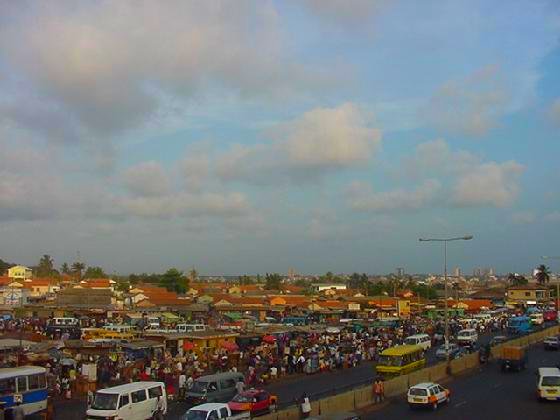
With a population of approximately 1,970,400, Accra is the capital of Ghana. Located at 5°30' North, 0°10' West, it is Ghana's largest city and the administrative, communications, and economic center. Economic activities in Accra are financial, agriculture, fishing, and manufacturing processed food, lumber and plywood, textiles, clothing and chemicals
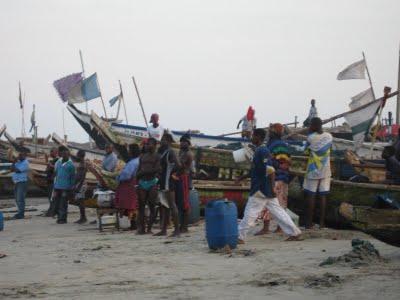
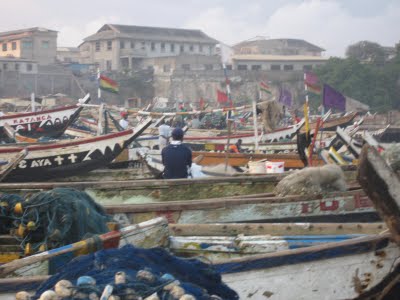
The city was first settled at the end of the sixteenth century when the Ga people migrated there after leaving their previous settlement at Ayawso, ten miles north of Accra. The site was advantageous as it removed the Ga people from the Akwamus people who were their rivals. The site also enabled the Ga people to engage in trade with the Europeans who had built forts nearby: James Fort and the Ussher Fort.
 |  |
Initially, Accra was not initially the most prominent trading center but the ports at Ada and Prampram, along with the inland centers of Dodowa and Akusa to the east. However, Accra took on more importance during slave trade due to the nearby forts (many of which were owned and controlled by the Dutch). This went on until the abolition of the slave trade in 1807. | 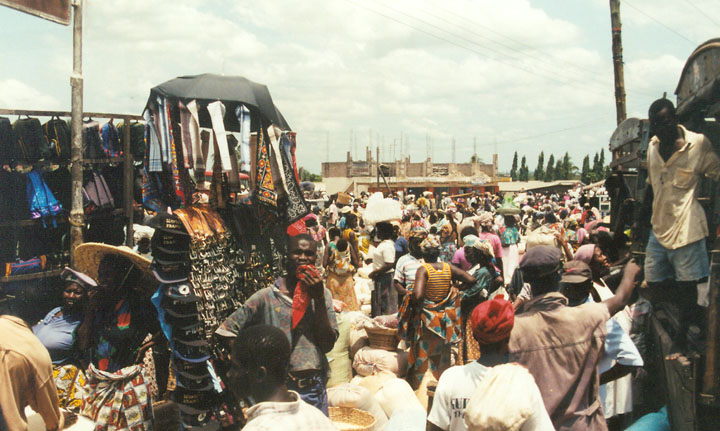 |
In the 1850s, the Dutch sold Christianborg and their other castles to the British. In 1873, after decades of an uneasy relationship between the British and the Acing people of central Ghana, the British attacked and virtually destroyed the Asanti capital of Kumasi, and officially declared Ghana a crown colony.
The British then moved their administrative capital from Cape Coast to Accra because Accra had a drier climate relative to Cape Coast, and was not home to the tsetse fly hence allowing the use animal transport. Until this time, the settlement of Accra was confined between the Ussher Fort to the East and the Koole Lagoon to the West.
One of the most influential decisions in the history of the city was that of building the Accra-Kumasi railway in 1908. This was to connect Accra, the major port at that time, with Ghana's main cocoa producing regions. In 1923, the railway was completed and by 1924 cocoa was Ghana's largest export.
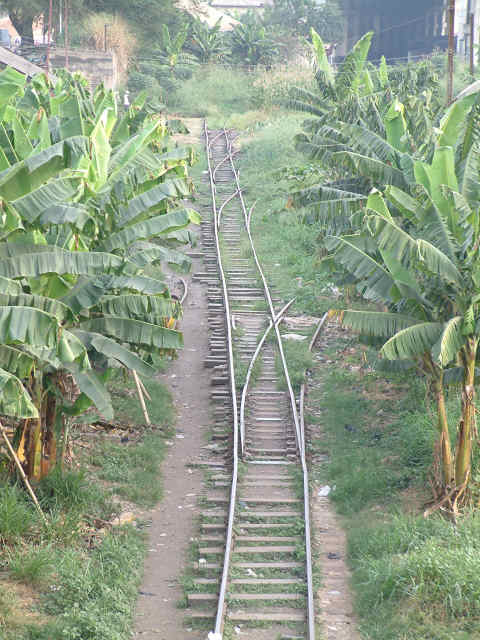
Accra was the main exporter of cocoa until 1928 and this was one of the main reasons for its rapid growth. Piped water was yet another factor that drew in many migrants from rural areas in 1915.
Accra prospered during the 1920s, and this has been associated with the influence of the governorship of Sir Frederick Gordon Guggisberg who had several changes done such as building a bridge across the Koole Lagoon in 1923, opening the land west of the lagoon for settlement, and building hospitals and schools. This led to an increase of Accra’s population due to migration of rural people into the city, and the immigration of increasing numbers of European businessmen and administrators. During the post-WWII more administrative, commercial buildings including a massive judicial/administrative complex were built.
The Accra Riots in 1948 launched the Ghanaian campaign for independence. Ghana gained its independence in 1957 with Kwame Nkrumah of the Convention People's Party as the president.
Today, Accra has several tourists’ attractions such as the National Museum of Ghana
the Ghana Academy of Arts and Sciences, the National Archives of Ghana, and Ghana's central library,
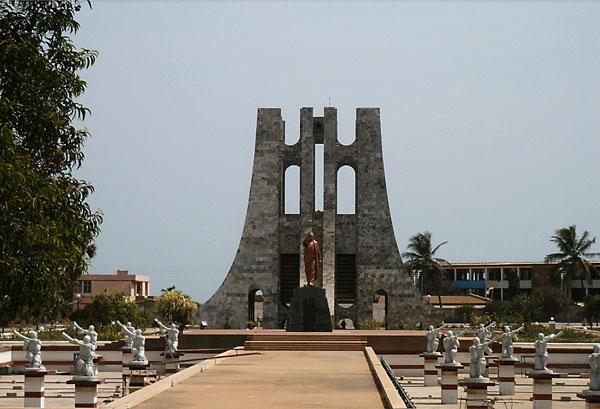
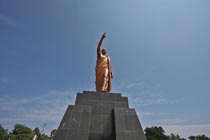
Dr. Kwame Nkrumah also know as the Kwame Nkrumah Memorial Park(KNMP) is the last resting place of the first President of Ghana, Osagyefo Dr. Kwame Nkrumah. It is dedicated to him for his outstanding campaign to liberate Ghana(by then Gold Coast) from colonial rule in 6th March,1957. | 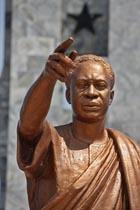 |
Dr. Nkrumah was overthrown by military government in 1966, after ruling for 9 years. He then went to exile in the Republic of Guinea. He fell ill and died in Bucharest, Romania 1972 when seeking medical treatment.
After 20 years of his death, Dr. Nkrumah's image was restored in 1st July, 1992 on the same grounds where he led Ghana to liberation from colonialism on 6th march 1957.
The Museum houses the personal effects and publications of Ghana's first president and pictures showing his life history.
Some of these pictures of Dr. Nkrumah with some of the most famous people of his time is an eye opener.
 | 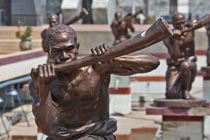 |
As you approach the main way leading to the Kwame Nkrumah Mausoleum, you'll see springs on either sides of the walk way. Each spring has seven bare-chested, squatting statuettes of flute blowers, who seem to welcome the arrival of world leaders and other important personalities.
The design of the Kwame Nkrumah Mausoleum, which represents swords turned upside down symbolizes peace. It can also be viewed as an uprooted tree to signify the unfinished work of Dr. Nkrumah to totally unite Africa.
This is a place you wouldn't want to miss during your stay in Ghana, since the transition of Gold Coast to Ghana happened on this same location. Kwame Nkrumah Mausoleum, is what some scholars call the "genesis" of the actual History of Ghana.
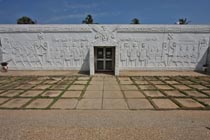 |  |
Wander through the photos, and you will be stunned at how many of the 20th century's most iconic people pictured shaking hands with the founder of modern Ghana.
He is pictured with famous people like Jawarharlal Nehru, Mao Zedong, Fidel Castro, Nikita Khrushchev, John F Kennedy of
U.S.A, Sir Alec Hume, Queen Elizabeth II
of England, Harold Macmillan, Pope Pius XII, President Nasser of Egypt, and countless leaders of countries like Malaya, Sri Lanka, Niger not forgetting Nigeria and many other more.
The body is buried under a catafalque raised in the centre of the park. | 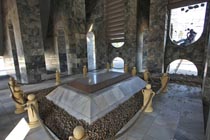 |
The Ghana Academy of Arts and Sciences, the National Archives of Ghana, and Ghana's central library,
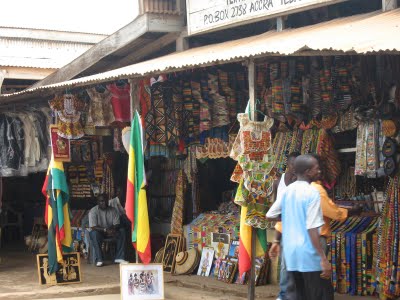 | 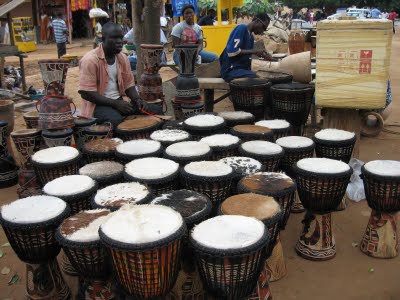 |
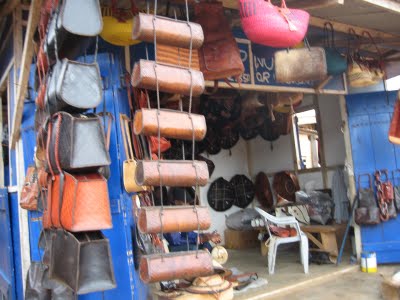
the National Theatre, Accra Centre for National Culture, a lighthouse,
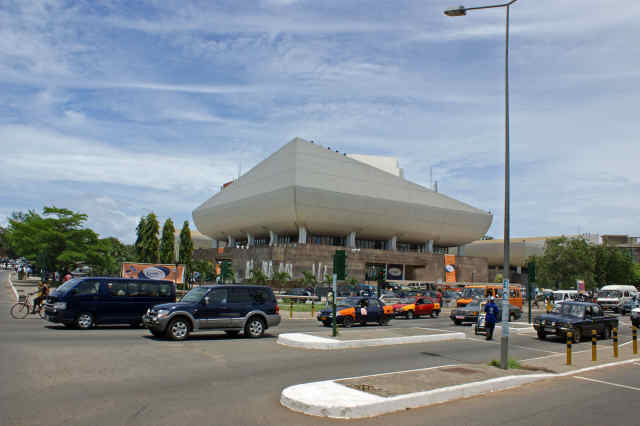
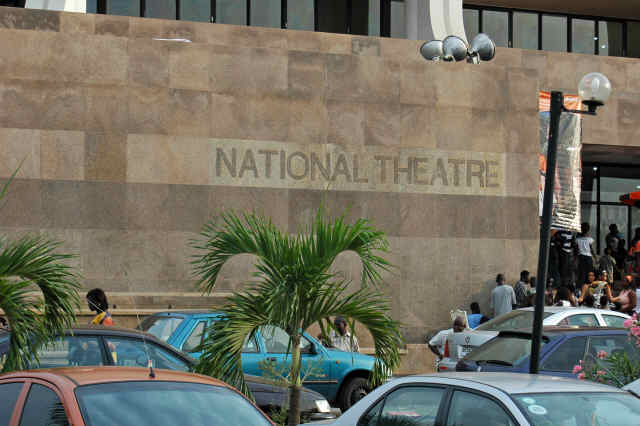
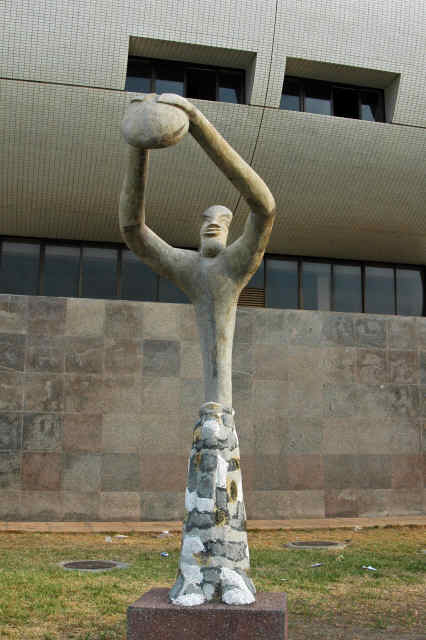 | 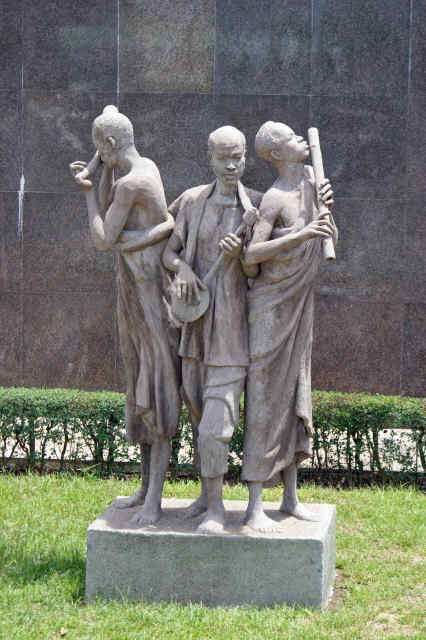 |
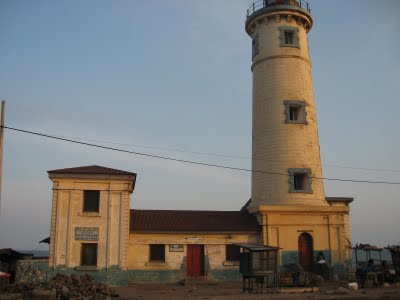
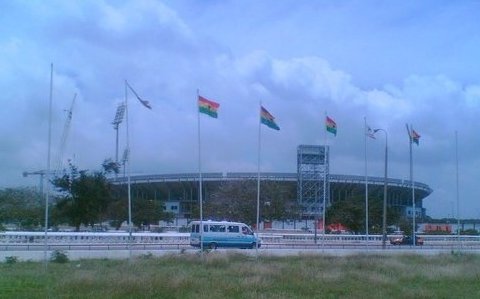
the National Sports Stadium among others.
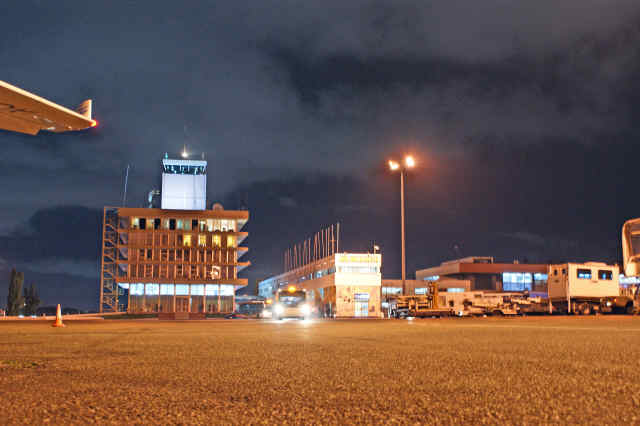
It is also a major transportation hub, home to the Kotoka International Airport and lies on railway lines to Tema, Takoradi and Kumasi.