Ghana's History
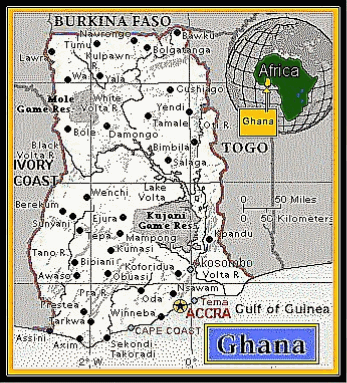 | The Republic of Ghana is a country in West Africa. Ghana is divided into ten (10) regions and subdivided into a total of 138 districts. |
The word Ghana means "Warrior King and was the source of the name "Guinea" (Via French Guinoye) that is used to refer to the West Africa coast (as in Gulf of Guinea).
Ghana was inhabited in pre-colonial times was inhabited in pre-colonial times By the latter of the 19th century, the Dutch and the British were the only traders left and after the Dutch withdrew in 1874, British made the Gold Coast a protectorate.
Trade with European states flourished after contact with the Portuguese in the 15th century, and the British established a crown colony, Gold Coast, in 1874.
As the first Sub-Saharan African nation to achieve independence from the United Kingdom in 1957, the name Ghana was chosen for the new nation to reflect the ancient Empire.
By the latter of the 19th century, the Dutch and the British were the only traders left and after the Dutch withdrew in 1874, British made the Gold Coast a protectorate.
Follow its conquest by the British in 1896, until independence in March 1957, the territory of modern Ghana was known as the Gold Coast, under British colonial rule
Well endowed with natural resources, Ghana has twice the per capita output of the poorer countries in West Africa.
Gold, timber, cocoa, diamond, bauxite, and manganese exports are major sources of foreign exchange.
An oil field which is reported to contain up to 3 billion barrels (480,000,000m3) of light oil discovered in 2007.
Oil exploration is ongoing and more is being found.
