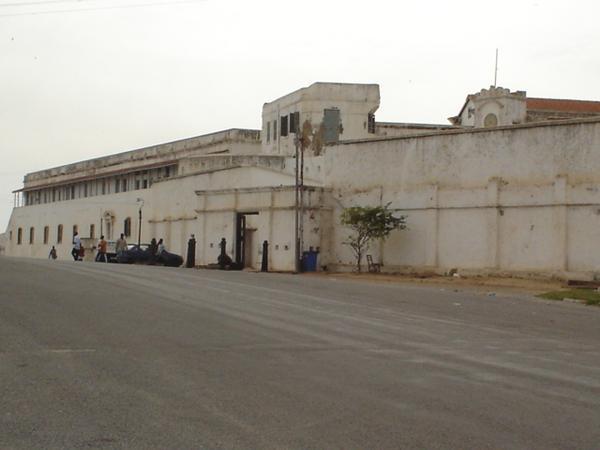
Cape Coast Castle
The door of no return, which for more than 100 years opened to the certainty of a short and brutal life for the millions of Africans that were captured off these shores and sold into slavery, now opens to the serene and awesome vastness of the Atlantic Ocean.
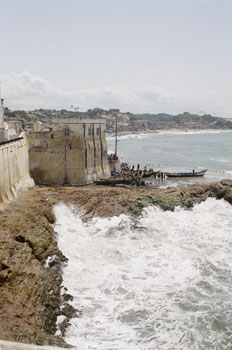
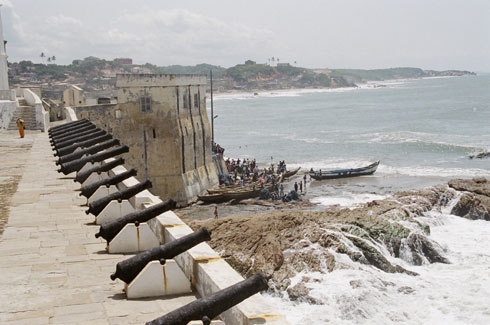
And the beach beyond the notorious exit door at Cape Coast Castle, which was the main British hub of the transatlantic slave trade in West Africa from 1665 to 1807, is now lined with an extensive slum of wooden shacks and colonial-era brick buildings covered with tin roofs
You have to use your imagination to understand what it must have been like to be here back then, to see the evil of what one man did to another.
And because people of all walks are compelled not only to imagine how the horror of slavery was implemented, but to walk and inhale the air in the dungeons where millions of Africans died -- in body and soul -- Cape Coast Castle remains as one of Ghana's key tourist attractions.
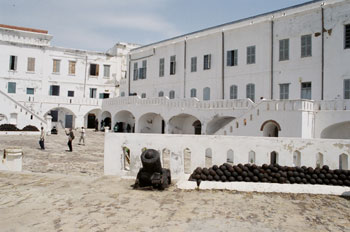
Originally built as a fort by the Swedes for their timber and mineral exportation, and then taken over by the Dutch before the English wrestled it away from them, the history of Cape Coast Castle remains the focal point of this coastal city. | 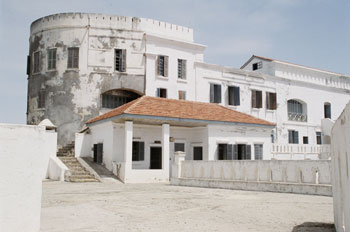 |
Cape Coast, a city of about a million people, was once the capital of what was then known as the Gold Coast. The British moved the capital to Accra in 1877.
However, the first European settlement on these shores was at a place called Elmina -- named so by the Portuguese who landed here in 1471. At Elmina, located about six miles from Cape Coast, the Portuguese built a similar castle, which also was the grounds of the slave market.
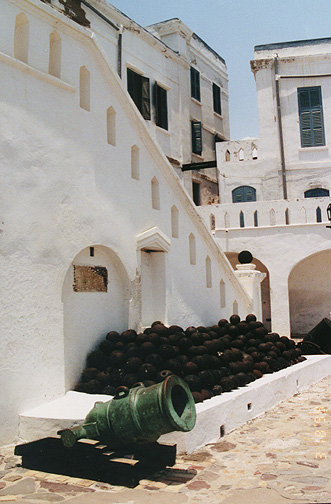
In Cape Coast, which was originally called Cabo Corso, its black cannons and mortars are still strategically placed on a concrete deck facing the ocean and on the rooftops of its towers on each side of the three-story main building.
The brick courtyard of the castle, which Ghanaians commonly refer to as Cape Coast Dungeon, has two 18-foot water wells and four graves.
In the first grave is the Rev. Phillip Quarcoo, the first black Anglican pastor, who died at the age of 75. Beside him lies C.B. Whitehead, a 38-year old British soldier who was killed by a Dutch soldier in the courtyard.
Letitia Elizabeth London died at 36. She was the wife of George McLean, the British administrator of the castle. He died at 46 and was buried next to his wife.
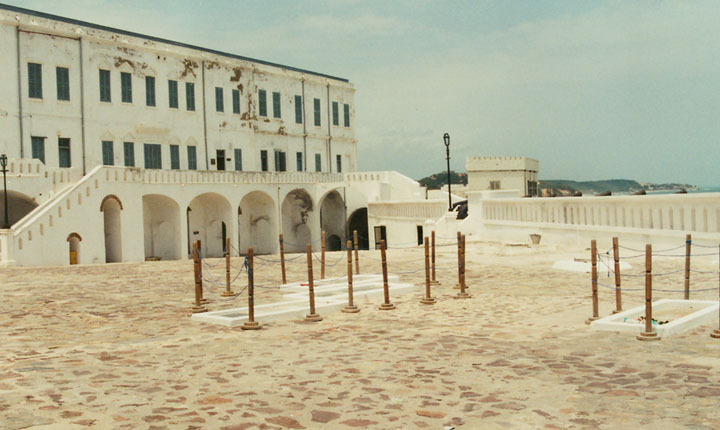
The hole leads into a deep and dark tunnel system that was used to takes slaves underneath the castle's courtyard, leading them to the "door of no return."
That hole is now covered by a white sheet and beneath it is a memorial shrine to all the souls that went through it. Beside it, tourists are allowed to place wreaths.
In an open auditorium on the top floor of the former administration building, an exhibit chronicles how slavery started on these shores.
It all started with a deep economic crisis in Europe in the 14th century. The Portuguese, who because of their location had a mastery of navigation on the high seas, set out in search of resources in the distant Africa.
They landed on the coastline of West Africa, rich in gold and ivory. They would name present-day Ghana the Gold Coast, and Ivory Coast was named so for its wealth in ivory.
But the Europeans, who also brought with them religion, particularly the English Methodist and Presbyterian missionaries who established themselves as the biggest Christian denominations on these shores, discovered something else: cheap labor.
To descend into the exposed brick castle is to enter what feels like the depth of the underworld.
Underneath the castle, there are five dungeon chambers for men. The strongest ones were separated during branding, when hot iron rods were used to mark their chests, and then chained and shackled together in the first chamber.
At any given three-month period, the castle held 1,000 men and 300 women. The men were confined in groups of 200 per chamber roughly the size of a 30-by-15-foot holding cell before they were shipped to America, the Caribbean and elsewhere.
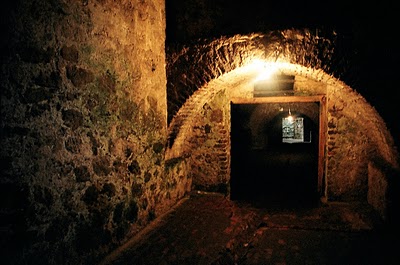
Women were locked in two similar dungeons, 150 of them per chamber. There were both commercial and domestic slaves. The domestic slaves served the British masters in and around the castle.
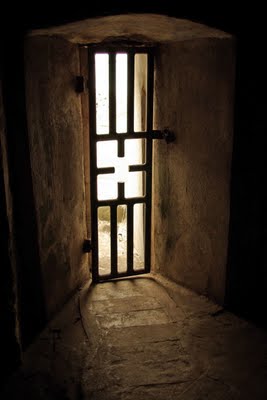
And any slave who challenged the authorities was thrown into the condemned cell, which held 50 in a room no bigger than most walk-in closets. There, they would die deprived of food, water, light and oxygen, clawing the brick walls and floors as they suffocated.
The majority of slaves ranged between 15 and 35 years of age.
Meanwhile, for the British traders, it was a life of relative comfort, discovery and adventure in their newfound home.
But it was not the British alone who were responsible for all the evil that happened in the confines of Cape Coast Castle, or for slavery itself.
After all, the African chiefs who controlled much of this region at the time played a major role as well.
They were the ones who paid the British and other Europeans by offering them slaves. They were the ones who sold women to British traders.
And because of that, the Ghana House of Chiefs -- a body comprising all the country's traditional kings and chiefs -- placed a plaque on one of the castle's walls, asking for forgiveness.
In 1998, the government of Ghana declared Aug. 1 as Emancipation Day and encouraged black people everywhere to return to Ghana and celebrate a sense of healing.
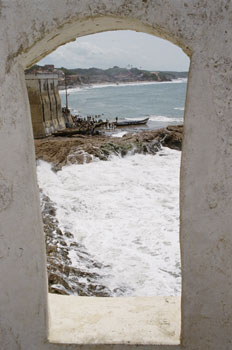
Outside the castle's notorious final exit door, the government established the concept of "a door of return."